

Si tu rêves de routes qui longent la mer à perte de vue, de falaises spectaculaires et de petits villages côtiers, ce road trip en Nouvelle Ecosse est fait pour toi ! Et quoi de mieux que de la découvrir en van ? Tu roules sur l’une des plus belles routes du Canada, tu t’arrêtes où tu veux, quand tu veux, pour profiter d’une plage improvisée, d’une baignade ou d’un resto de fruits de mer les pieds dans l’eau. Explore à ton rythme, sans horaire ni contrainte : voilà tout l’esprit de la vanlife.
Tu cherches une van aménagée pour partir en road trip ? Réserve la tienne dès maintenant et pars à l’aventure !
On t’a préparé un itinéraire complet, du départ de Québec, avec les incontournables et quelques détours qui valent vraiment le coup. On y va ? 🚐
Sommaire
Première étape : L’arrivée en Nouvelle Écosse
Le départ se fait en douceur… enfin, façon de parler, parce que la route est longue ! Compte environ 9 heures de route au départ de Québec, traversée en ferry sur la baie de Fundy incluse. Cette traversée, c’est déjà une aventure en soi : les marées de la baie de Fundy sont parmi les plus fortes au monde, alors garde l’œil ouvert, tu pourrais même croiser une baleine ou deux depuis le pont du bateau.
Comme c’est une grande distance à parcourir, on te conseille de faire la route en plusieurs fois, avec une ou deux nuits au Nouveau-Brunswick en chemin. Ça te laisse le temps de souffler, de découvrir un peu la région et d’arriver à Digby reposé•e.

1er jour en Nouvelle-Écosse : Digby
Bienvenue en Nouvelle-Écosse ! Après la traversée en ferry, rendez-vous tout près, à Digby, où tu peux passer un bon moment avant de reprendre la route. Cette petite ville portuaire est reconnue pour ses bateaux de pêche colorés qui se bousculent dans le port et pour une des plus importantes flottilles de pêche au homard et aux pétoncles de la province. Tu peux aussi réserver une excursion d’observation des baleines au large de Brier Island, une activité qui soutient directement la recherche marine locale.
Tu peux passer la nuit là ou t’avancer vers le prochain point pour être déjà sur place.
Digby – Park national Kejimkujik : 1h de route
Jours 2 et 3 : Parc national Kejimkujik
Le parc Kejimkujik est un parc chargé d’histoire. C’est un territoire ancestral des Mi’kmaq, et tu peux d’ailleurs y découvrir des pétroglyphes et en apprendre davantage sur cette culture millénaire au fil de ta visite.
Mi’kmaq : C’est le nom d’un peuple autochtone (Première Nation) d’Amérique du Nord. Leurs terres ancestrales, appelées le Mi’kma’ki, englobent les provinces maritimes du Canada (Nouvelle-Écosse, Nouveau-Brunswick, Île-du-Prince-Édouard), la Gaspésie au Québec, ainsi qu’une partie de Terre-Neuve et du Maine (États-Unis).
Pétroglyphes : désigne des dessins, des motifs ou des symboles gravés dans la roche par des peuples autochtones.
Côté activités, le parc est un paradis pour les baroudeurs et baroudeuses qui aiment bouger: canot, planche à pagaie, randonnée et vélo : de quoi occuper facilement une journée complète !
Petite subtilité à connaître : Kejimkujik est en fait divisé en deux sections bien distinctes. On te conseille de passer une première journée à l’intérieur des terres, avec ses lacs tranquilles, ses forêts et ses sentiers de canot, et d’y dormir pour la nuit. Le lendemain, tu prends la route vers la seconde section, Kejimkujik Seaside, à environ une heure plus au sud du côté de Port Joli. Ici, le décor change complètement : plages de sable blanc sauvages, phoques qui se prélassent sur les rochers et sentiers côtiers. Un vrai contraste avec la section intérieure, et clairement à ne pas manquer si tu as le temps.
Port Joli – Halifax : 1h30 de route
Jour 4 : Halifax

Impossible de faire l’impasse sur Halifax. La capitale de la Nouvelle-Écosse abrite le deuxième plus grand port naturel au monde, et son centre-ville vibre encore aujourd’hui au rythme des traditions celtiques et gaéliques héritées des premiers colons écossais.
Prends le temps de flâner sur le bord de mer, de visiter la citadelle qui surplombe la ville, et de t’imprégner de cette ambiance maritime unique où la musique traditionnelle n’est jamais bien loin dans les pubs du coin. C’est vraiment un arrêt obligatoire de ton road trip.
Halifax – Liscomb : 2h30 de route
Jour 5 : Longe la côte jusqu’à Liscomb
De Halifax, la route suit la côte Est vers Liscomb. En chemin, la route est magnifique et beaucoup moins fréquentée que le Cabot Trail (dont on te parle un peu plus loin). C’est le genre de trajet où tu prends ton temps, où tu t’arrêtes dès qu’un point de vue te tape dans l’œil. Sheet Harbour peut être un bon arrêt pratique en chemin pour faire le plein d’essence et de provisions.

Direction Liscomb, où tu pourras t’installer pour la nuit. C’est aussi un très bel endroit pour prendre le temps de t’y arrêter, grâce à sa nature très préservée : des forêts, des rivières et des criques, des sentiers de randonnée tranquilles, et une atmosphère beaucoup plus calme et isolée que les endroits plus touristiques.
Liscomb – Île de Cap-Breton : 3h de route
Jours 6 et 7 : Île de Cap-Breton et Cabot Trail
C’est LE moment fort du voyage. Le Cabot Trail, cette route qui fait le tour de l’île du Cap-Breton, est considérée comme l’une des plus belles routes panoramiques du Canada. On te conseille de la parcourir dans le sens antihoraire pour profiter des meilleurs points de vue.
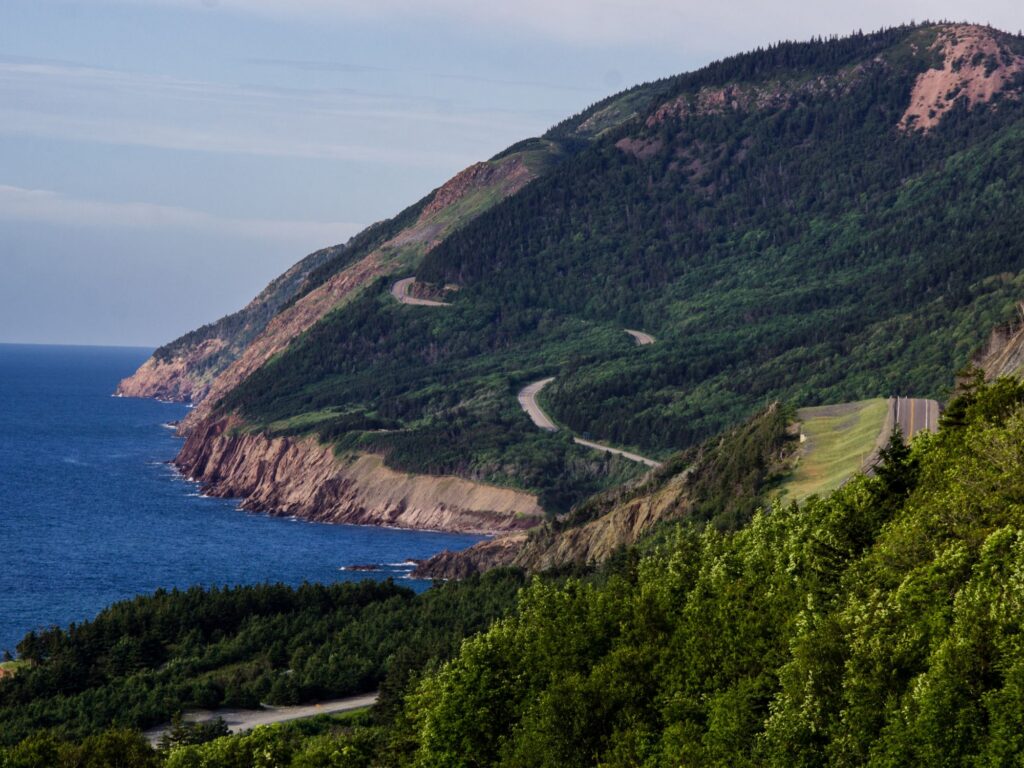
Deux arrêts qu’on te recommande vraiment de ne pas manquer :
- Le village isolé de Meat Cove, tout au bout de la route, avec ses falaises spectaculaires sur l’océan.
- Le sentier Skyline est probablement la randonnée la plus emblématique de toute la Nouvelle-Écosse, avec une plateforme d’observation suspendue au-dessus de l’Atlantique.
💡 On en parle plus en détail dans notre article Est du Canada : les 5 routes iconiques du pays, si tu veux tout savoir avant de partir.
Compte environ 5h30 de route pour faire le tour complet de l’île et revenir jusqu’au pont de Port Hastings.
Puis Port Hastings – Caribou : 1h40 de route
Jour 8 : Caribou-Munroes Island Provincial Park
Notre dernier arrêt se trouve à Caribou-Munroes Island Provincial Park, pour clore ce chapitre de Nouvelle-Écosse en douceur. C’est une grande plage de sable, avec une eau qui compte parmi les plus chaudes de la province en été. Si la météo te le permet, c’est le moment idéal pour une petite baignade.
L’endroit est parfait pour un pique-nique ou simplement pour t’installer un moment et profiter du sable et du soleil, un dernier arrêt tranquille avant de repartir.
Le retour à Québec
La dernière étape est la plus longue : compte environ 12 heures pour rentrer au Québec. Encore une fois, on te conseille fortement de la découper en prévoyant un ou deux arrêts en chemin, ton corps (et ton copilote) te remercieront. C’est aussi l’occasion parfaite de faire quelques dernières nuits improvisées quelque part au Nouveau-Brunswick avant de rentrer.


Recent Comments